
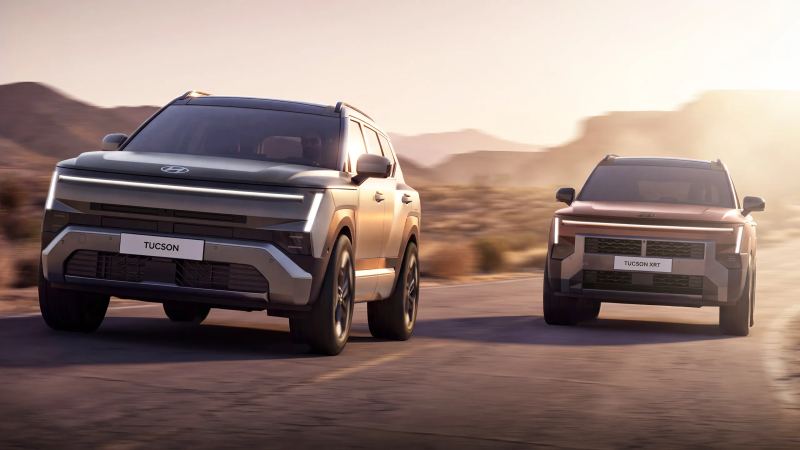
Hyundai has spent the past decade establishing a reputation for bold moves, whether through its N Performance models or futuristic styling. The South Korean automaker continues that approach with the all-new Tucson, which makes a particularly strong visual statement.
First previewed in August and now fully revealed in New York City, the latest Tucson bears little resemblance to its predecessor. It shares the new Elantra’s Art of Steel design philosophy and pairs the dramatic exterior with a completely revised interior. Depending on the market, buyers will have three powertrain options.
Entry-level fifth-generation Tucson models will use either Hyundai’s familiar 1.6-liter turbocharged four-cylinder or a 2.0-liter naturally aspirated four-cylinder, depending on the market. Output will range from 148 hp to 190 hp, with torque figures spanning 141 lb-ft (191 Nm) to 195 lb-ft (264 Nm). Available transmissions include six-speed manual, seven-speed dual-clutch, eight-speed automatic, and six-speed automatic units, though Hyundai has not confirmed which combinations will be offered in the US.
The more notable additions are the Tucson Hybrid and Tucson Plug-In Hybrid, both of which pair the 1.6-liter turbocharged four-cylinder with an electric motor. The Tucson Hybrid uses a compact 1.49 kWh battery and a six-speed automatic, completing the 0-60 mph (0-96 km/h) sprint in a quoted 8.5 seconds. Depending on the market, its output ranges from 233 hp to 242 hp, while torque is rated at 280 lb-ft (380 Nm).
Hyundai has substantially revised the PHEV, which now produces 288 hp and 258 lb-ft (350 Nm). It comes exclusively with a six-speed transmission and four-wheel drive, enabling a 7.9-second 0-60 mph run. Its 17.1 kWh battery provides up to 50 miles (81 km) of all-electric driving range.
A Production SUV With Concept-Car Styling
Hyundai calls the new Tucson “The Boldest SUV,” a description supported by its dramatic appearance. While the outgoing model is already distinctive, the new version looks closer to a concept car or moon rover than a conventional production SUV. Long-wheelbase models destined for North America, Korea, and Australia grow by 2.3 inches (60 mm) in length, 1.5 inches (40 mm) in width, and 0.8 inches (20 mm) in height. The wheelbase increases by 1.1 inches (30 mm) to 109.6 inches (2,785 mm), while Europe will receive a short-wheelbase version.
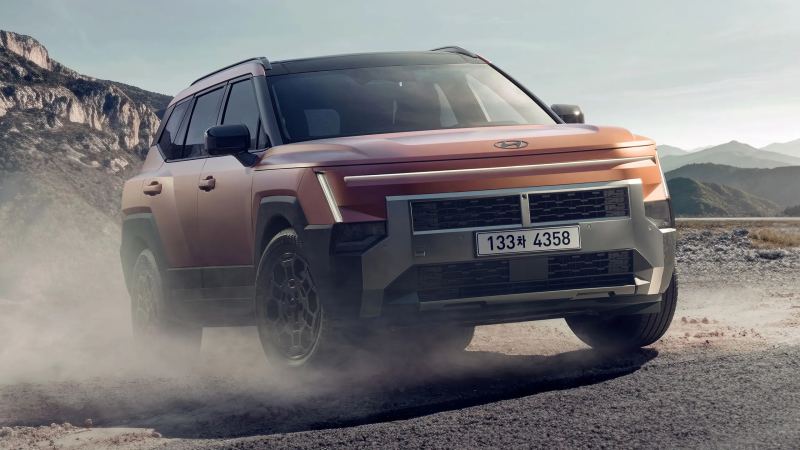
The Tucson’s front end features a light bar, upright daytime running lights, and a substantial bumper with black lower grilles and darkened headlamp clusters. Hyundai has pushed the angular styling of the fourth-generation model even further, adding square fender flares and similarly sharp quarter panels.
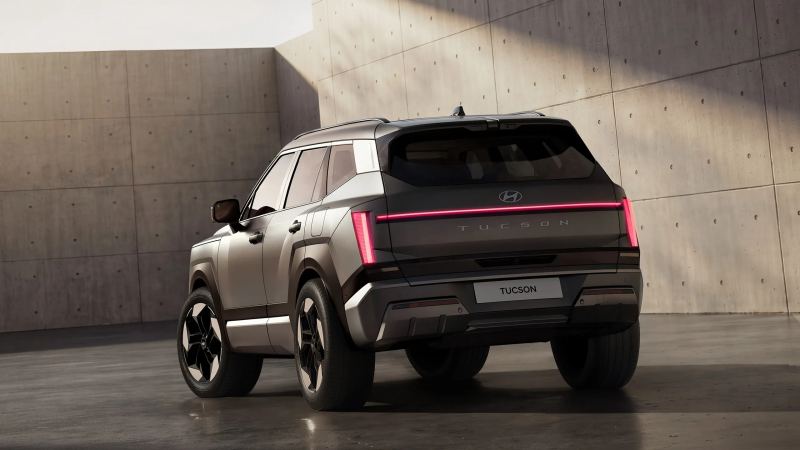
The styling is certain to divide opinion, which may be precisely Hyundai’s intention. The rear follows the same bold theme with another light bar, vertical taillights, black trim, and a bumper designed to be as dramatic as the front fascia.
The cabin receives an equally radical makeover. Hyundai’s new Android Automotive-based Pleos Connect infotainment system takes center stage, with either a 12.9-inch display or the larger 17-inch screen shown in the official photos. A compact 9.9-inch digital gauge cluster is also available, although it is optional on the Korean base model.
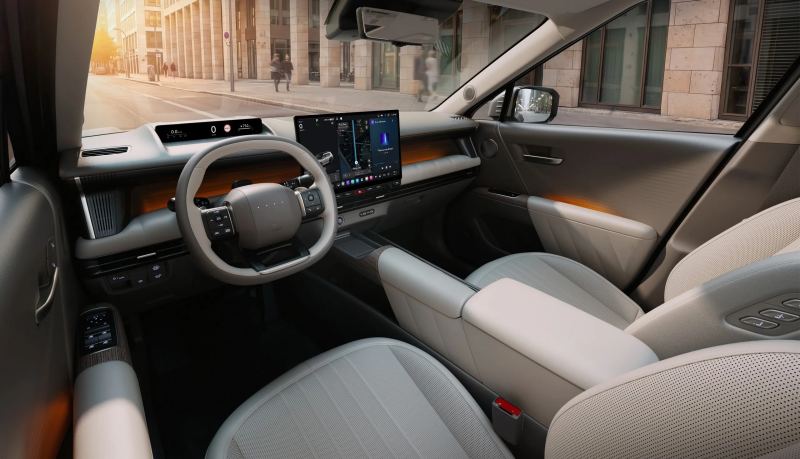
The new technology is paired with a redesigned dashboard and an unusual tiered transmission tunnel. Its raised section includes a wireless charger for the driver, while the recessed portion adds two cupholders and a passenger-side charger. Other cabin features include ambient lighting, plush seats, and a column-mounted shifter.
Hyundai has also introduced two more rugged versions, the Tucson XRT and Tucson XRT Pro, with the latter available exclusively in North America. Both receive more aggressive styling, while the XRT Pro adds all-terrain tires, front recovery hooks, and improved approach and departure angles. Hyundai also says a “sport-inspired” Tucson will debut at next week’s Paris Motor Show, although details remain secret. It is likely to be a new N-Line model.
South Korea will be the first market to receive the new Tucson, with arrivals scheduled for later this year. The SUV will then reach North America, Europe, and other markets in 2027.
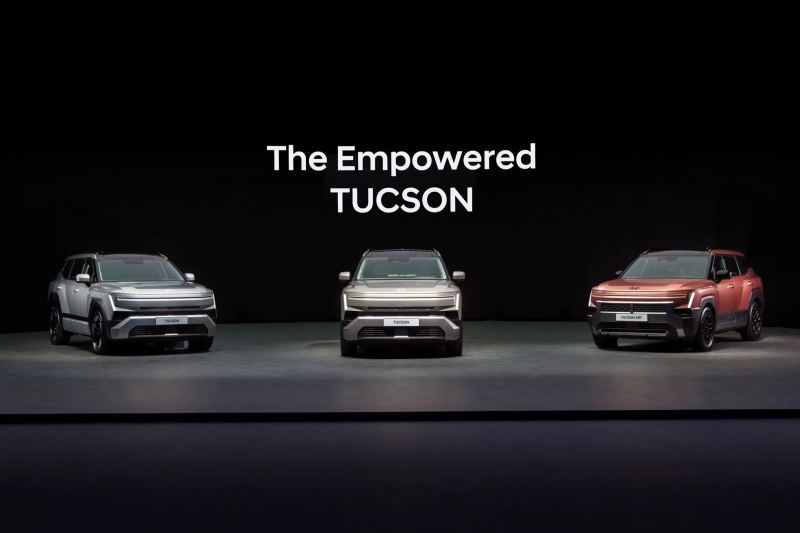
The fifth-generation Hyundai Tucson brings a dramatic Art of Steel exterior, a thoroughly redesigned cabin, and gasoline, hybrid, and plug-in hybrid powertrains that vary by market. The new Tucson Hybrid produces up to 242 hp, while the PHEV makes 288 hp and offers 50 miles of electric range. South Korea receives it first, with other markets following in 2027.


The Toyota RAV4 remains a popular compact SUV, but its value and capabilities face strong competition from five hybrid alternatives.

Volkswagen has owned Bentley since 1998, but the luxury marque remains closely tied to its historic Crewe factory, where its current models are assembled in England despite their extensive German engineering and component links.

Tesla’s latest Roadster remains unconfirmed for production, but its dramatic debut included airborne stunts that few cars could match.

A fire at Frank Kent Cadillac in Fort Worth, Texas, destroyed six electric SUVs believed to be Cadillac Escalade IQs and took nearly 18 hours to bring under control.

A Ferrari F50 with just 106 miles on its odometer is expected to surpass $20 million at auction on October 31, potentially setting a new record for the model and highlighting its rapid rise in collector value.