
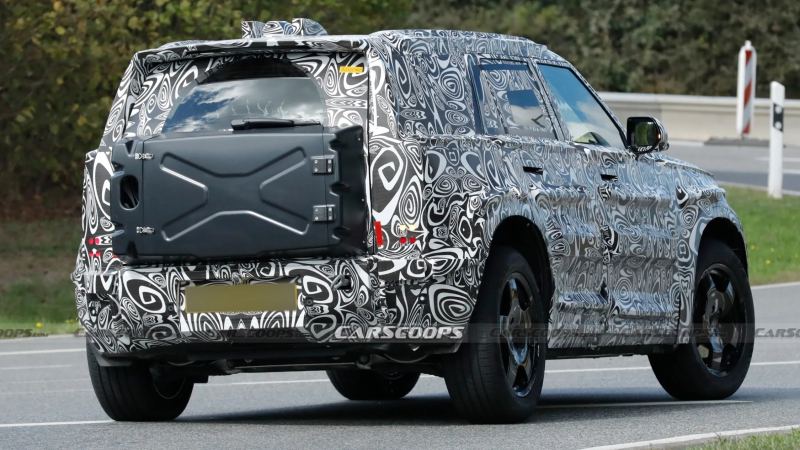
Land Rover is developing a smaller version of its hugely popular Defender, likely to be called Defender Sport. However, the compact SUV will have less trunk space than its larger sibling, so the company appears to be exploring new ways to add practical storage.
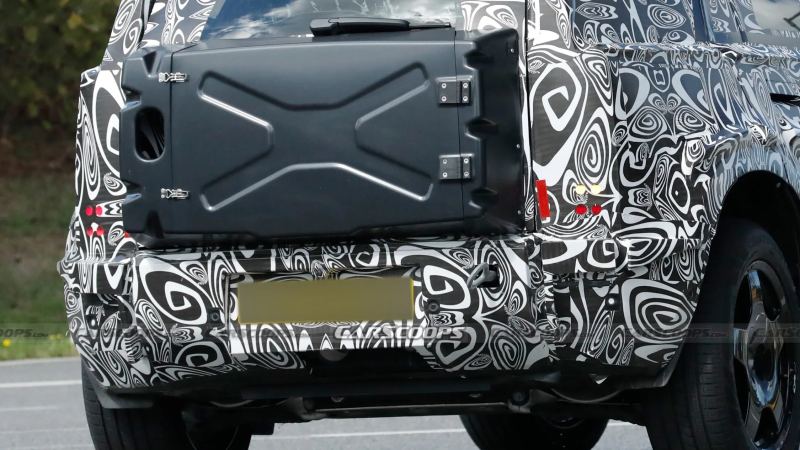
Fresh spy photos taken near JLR’s Nürburgring base show the baby Defender carrying a peculiar rectangular box mounted to the exterior of its side-hinged rear door. Its shape does not match a conventional spare wheel, which was fitted to another prototype spotted earlier this month. The absence of camouflage also suggests Land Rover wants the unusual component to attract attention.
The box in these images is likely being used to conceal whatever lies beneath it and probably will not be offered on the Defender Sport when it reaches the market next year. One possibility is a dedicated compartment for a charging cable, similar to the Design box Mercedes offers for its slow-selling electric G-Class.

Storing charging cables can be difficult in many EVs, particularly those without a frunk and those carrying plenty of equipment in the trunk. Mercedes’ Design box addresses the issue by placing the cable in an easily accessible compartment on the rear door. Its mini spare-wheel appearance also suits the rugged SUV’s styling.
Land Rover could take a different approach, perhaps designing the compartment to resemble the side-panel boxes fitted to the larger Defender. On versions without the rear-mounted spare wheel—which adds weight and reduces an EV’s range—the same space could house a tire-repair kit while preserving the visual theme.
Hybrid And Electric
A charging-cable compartment may not be necessary on every Defender Sport. The EMA platform shared with the new Range Rover GT coupe was initially developed for EVs and includes 800-volt electrical hardware for fast charging, but it has since been adapted for hybrid power. Unlike some premium SUV makers, Land Rover will reportedly avoid plug-in powertrains and concentrate on conventional full-hybrid technology.
Moving from an all-electric strategy to petrol-electric power was crucial to the SUV’s prospects in the US, which is expected to be its largest market. EV sales have fallen sharply there while demand for hybrids is increasing. In Europe, where electric-car sales are reaching new highs and one in four new cars is electric, the EV version should prove especially popular. The Defender Sport will face competition from Mercedes, which is developing a smaller G-Class with a similar concept. Like Land Rover’s compact SUV, the smaller G-Class is expected to offer hybrid and electric powertrains, setting up a close rivalry by this time next year.


The Toyota RAV4 remains a popular compact SUV, but its value and capabilities face strong competition from five hybrid alternatives.

Volkswagen has owned Bentley since 1998, but the luxury marque remains closely tied to its historic Crewe factory, where its current models are assembled in England despite their extensive German engineering and component links.

Tesla’s latest Roadster remains unconfirmed for production, but its dramatic debut included airborne stunts that few cars could match.

A fire at Frank Kent Cadillac in Fort Worth, Texas, destroyed six electric SUVs believed to be Cadillac Escalade IQs and took nearly 18 hours to bring under control.

A Ferrari F50 with just 106 miles on its odometer is expected to surpass $20 million at auction on October 31, potentially setting a new record for the model and highlighting its rapid rise in collector value.