
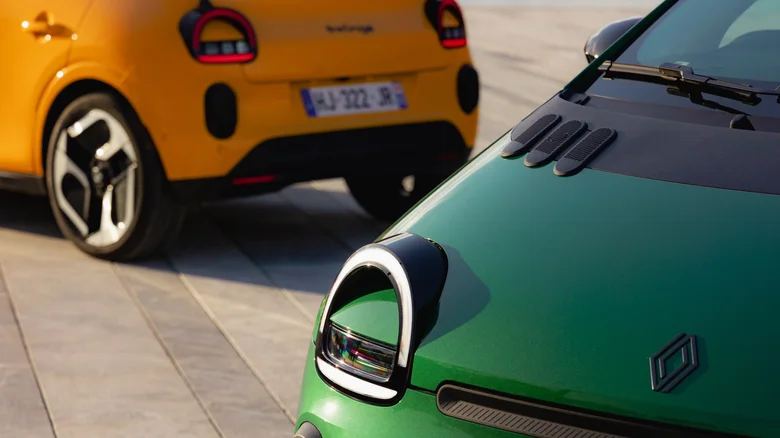
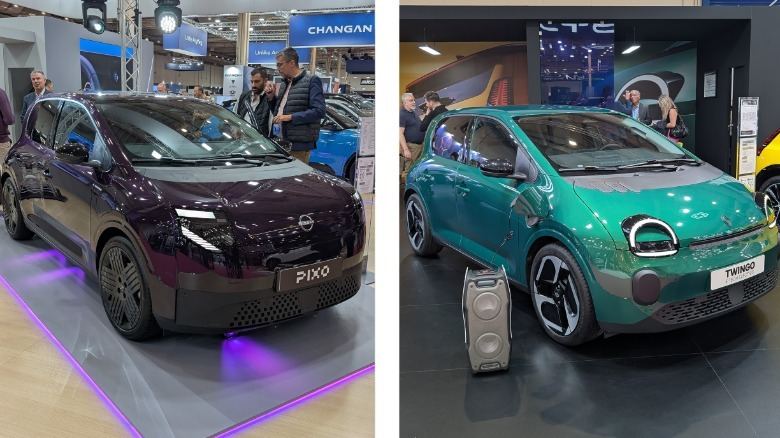
We recently examined the shared components used by the Renault Twingo E-Tech and its Nissan Pixo twin, noting that the new Dacia Spring achieves a more distinctive appearance despite relying on the same underpinnings. Renault now appears to share that concern and is asking its partners to create greater separation between jointly developed vehicles in the future.
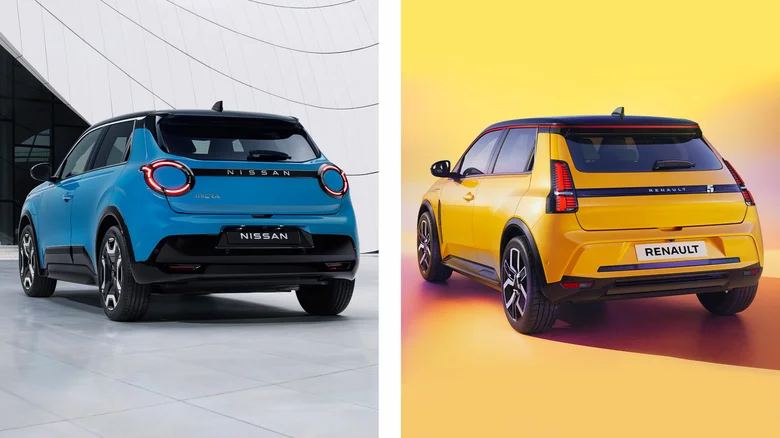
According to Autocar, which cited sources familiar with the matter, Renault executives were dissatisfied with the visual resemblance between the Nissan Micra EV and Renault 5 E-Tech. The reaction is notable because both subcompact hatchbacks use the same proportions, hard points, greenhouse and roof section, even though Nissan redesigned almost every exterior body panel.
That reaction raises questions about how Renault views the Nissan Pixo and Renault Twingo E-Tech, as well as the Mitsubishi Eclipse Cross EV and Renault Scenic E-Tech. Mitsubishi’s rebadging of the Renault Clio, Captur and Symbioz for the European market is an even more obvious example of limited differentiation.
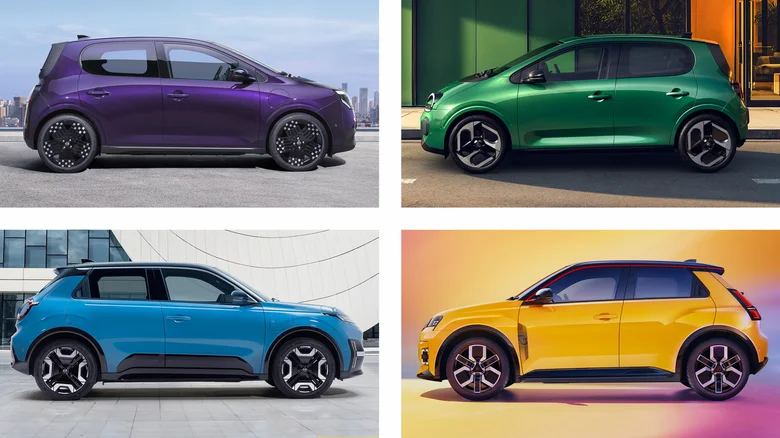
Speaking at the Paris Motor Show, Renault Group CEO François Provost outlined a change in approach to platform sharing with Alliance partners Nissan and Mitsubishi, along with other automakers such as Ford. Unlike his predecessor, Luca de Meo, Provost is placing greater emphasis on protecting Renault’s design identity.
Provost told Autocar that Renault had previously failed to demand enough separation between partner models: “We did not request enough differentiation. Everything is linked to differentiation. Look at the Dacia Spring: the Twingo and Spring look like different cars but the platform is the same. This is a change compared with my predecessor. I will never do partnerships without enough differentiation.”
The design teams at the individual automakers are not primarily responsible for shared body panels or identical cabins. Those decisions are made by product-planning departments, which give designers a defined degree of freedom while keeping projects within strict budgets. As with a mid-cycle facelift, changing bumpers and lighting units is considerably cheaper than reworking profile sheet metal or making structural alterations to the chassis.
Provost also discussed Renault’s new joint program with Ford. The Blue Oval is developing a fully electric successor to the discontinued Fiesta, using the same architecture as the Renault 5 E-Tech and Nissan Micra. According to the Renault chief, Ford CEO Jim Farley has “exactly the same views” on platform sharing and visual differentiation.
Provost said Farley’s position was that “if he chose to partner with Renault, the car must be a Ford.” Renault executives do not have access to the design of the upcoming Ford-badged EV, however, meaning Provost will not see the finished vehicle until its unveiling. He added: “I prefer to do less partnerships with strategic partners who want a one-shot tactical partnership and more for the long-term. Now you will see each time is with enough differentiation.”
Renault Group is not alone in calling for more distinctive styling among vehicles that share modular platforms and powertrains. Stellantis has made a similar promise for future models, while Volkswagen Group has faced comparable challenges and has nevertheless developed separate design identities for its brands over the years.
Renault Group CEO François Provost says future partnerships must deliver much stronger visual differentiation, following criticism of similarities between models such as the Renault 5 E-Tech and Nissan Micra EV. The policy will also apply to Renault’s project with Ford, whose electric Fiesta successor will share architecture with the Renault 5 and Nissan Micra while retaining a clearly recognizable Ford identity.


The Toyota RAV4 remains a popular compact SUV, but its value and capabilities face strong competition from five hybrid alternatives.

Volkswagen has owned Bentley since 1998, but the luxury marque remains closely tied to its historic Crewe factory, where its current models are assembled in England despite their extensive German engineering and component links.

Tesla’s latest Roadster remains unconfirmed for production, but its dramatic debut included airborne stunts that few cars could match.

A fire at Frank Kent Cadillac in Fort Worth, Texas, destroyed six electric SUVs believed to be Cadillac Escalade IQs and took nearly 18 hours to bring under control.

A Ferrari F50 with just 106 miles on its odometer is expected to surpass $20 million at auction on October 31, potentially setting a new record for the model and highlighting its rapid rise in collector value.