
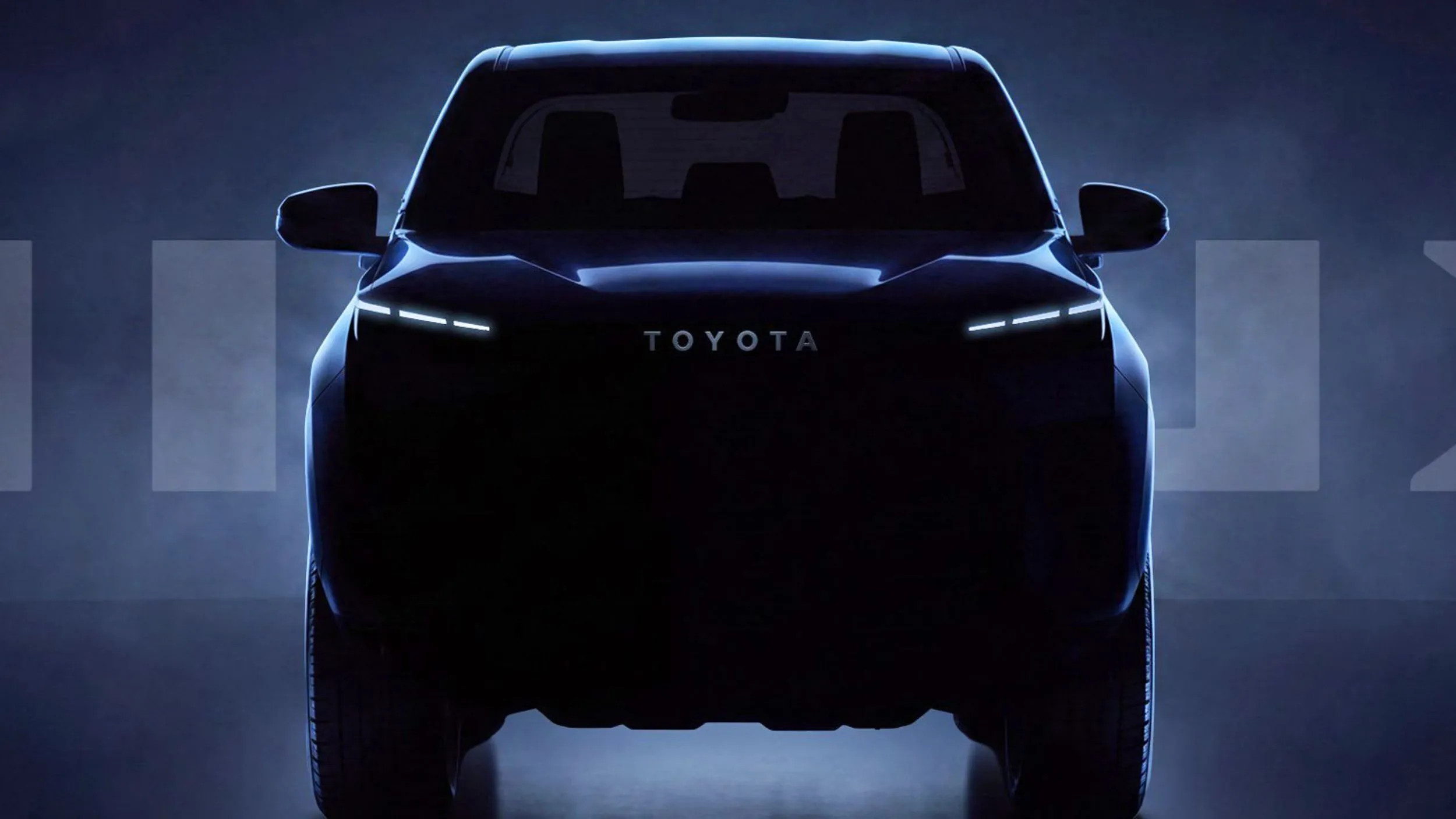
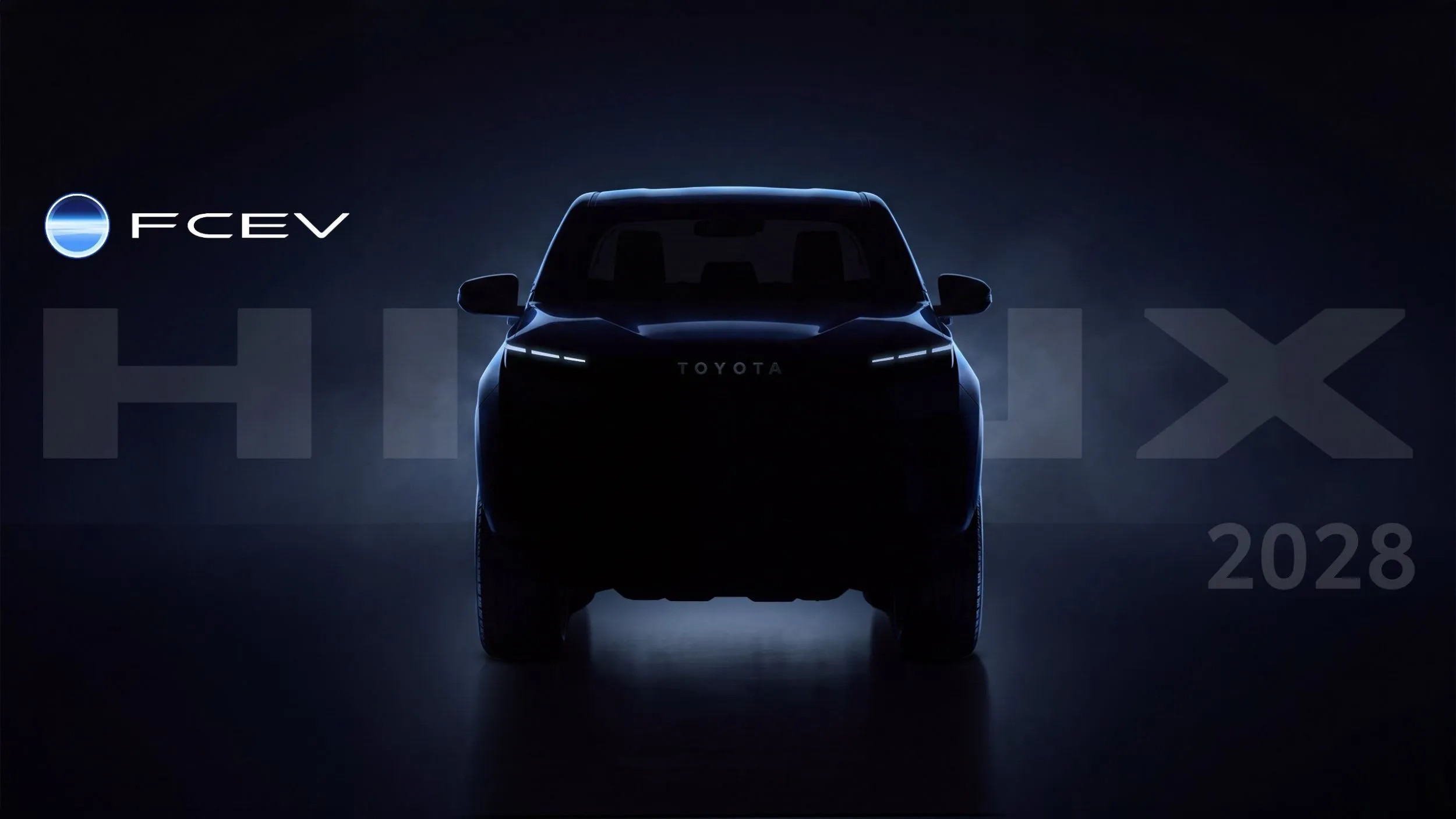
Toyota is continuing its multi-pathway strategy with plans to produce the Hilux FCEV in 2028. The midsize pickup will receive a hydrogen fuel cell powertrain for the European market, where it will be offered alongside the current mild-hybrid diesel and fully electric versions.
After developing several prototypes based on the previous-generation truck, Toyota has released the first teaser image of the new Hilux FCEV.
The teaser appears to show a distinctive lighting design with segmented daytime running lights. However, its dark presentation makes it difficult to identify styling changes from the standard Hilux or determine whether the FCEV will use the BEV’s bumper and closed-off grille.
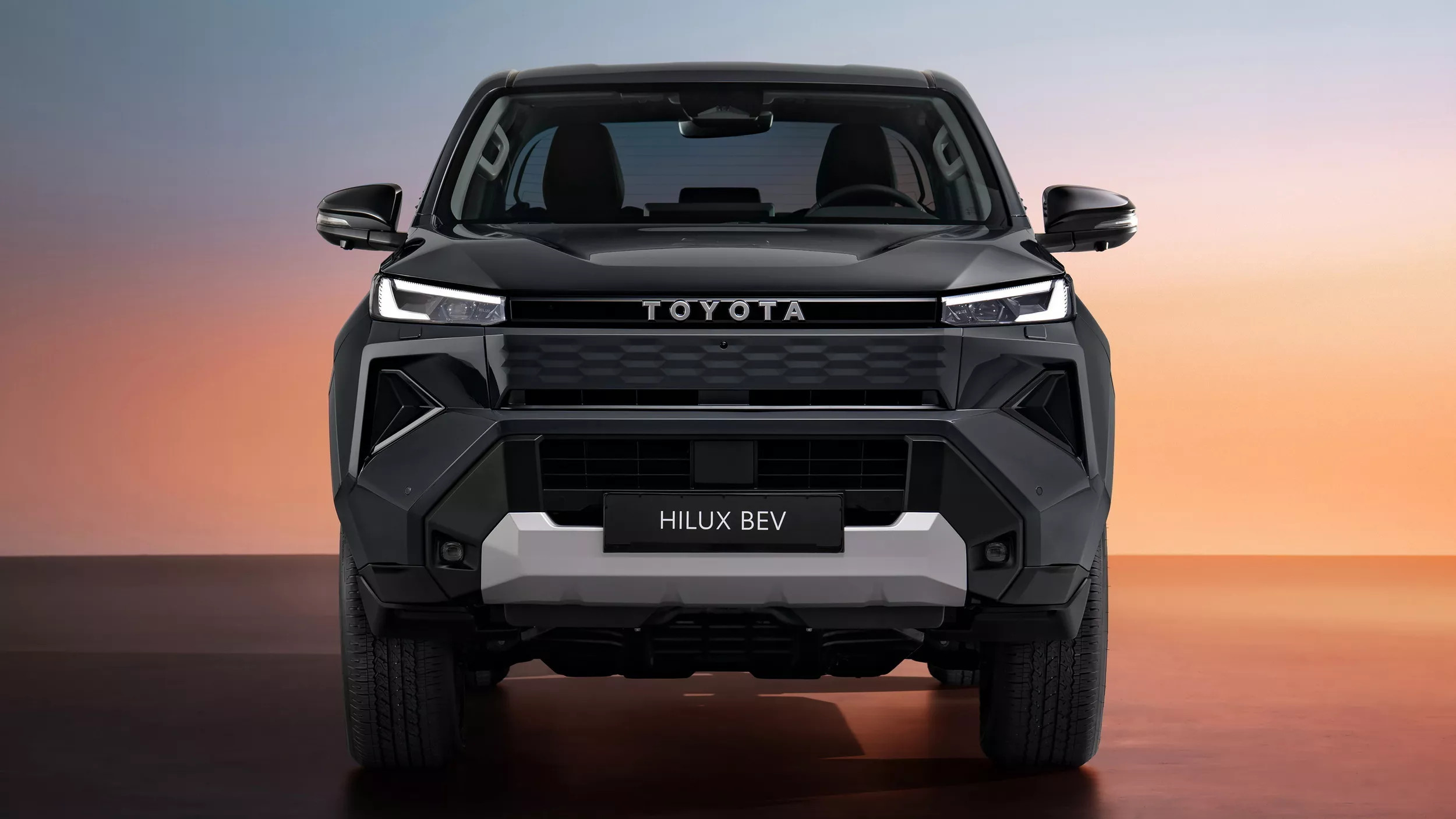
Toyota has not yet revealed the full specifications, but it is targeting a WLTP range of more than 248 miles (400 km) and a towing capacity of 2,500 kg (5,512 lbs). By comparison, the Hilux BEV offers a WLTP range of 257 km (159 miles) and can tow between 1,600 and 2,000 kg (3,530-4,410 lbs), depending on its configuration and applicable regulations.
Hydrogen’s main advantage is its faster refueling time, which can be as little as five minutes—provided the necessary infrastructure is available. The European Hydrogen Observatory lists 179 operational hydrogen refueling stations across Europe and the UK, suggesting that the Hilux FCEV will remain a niche proposition for now.
Price will present another obstacle, since hydrogen-powered vehicles are generally considerably more expensive than comparable ICE and BEV models.
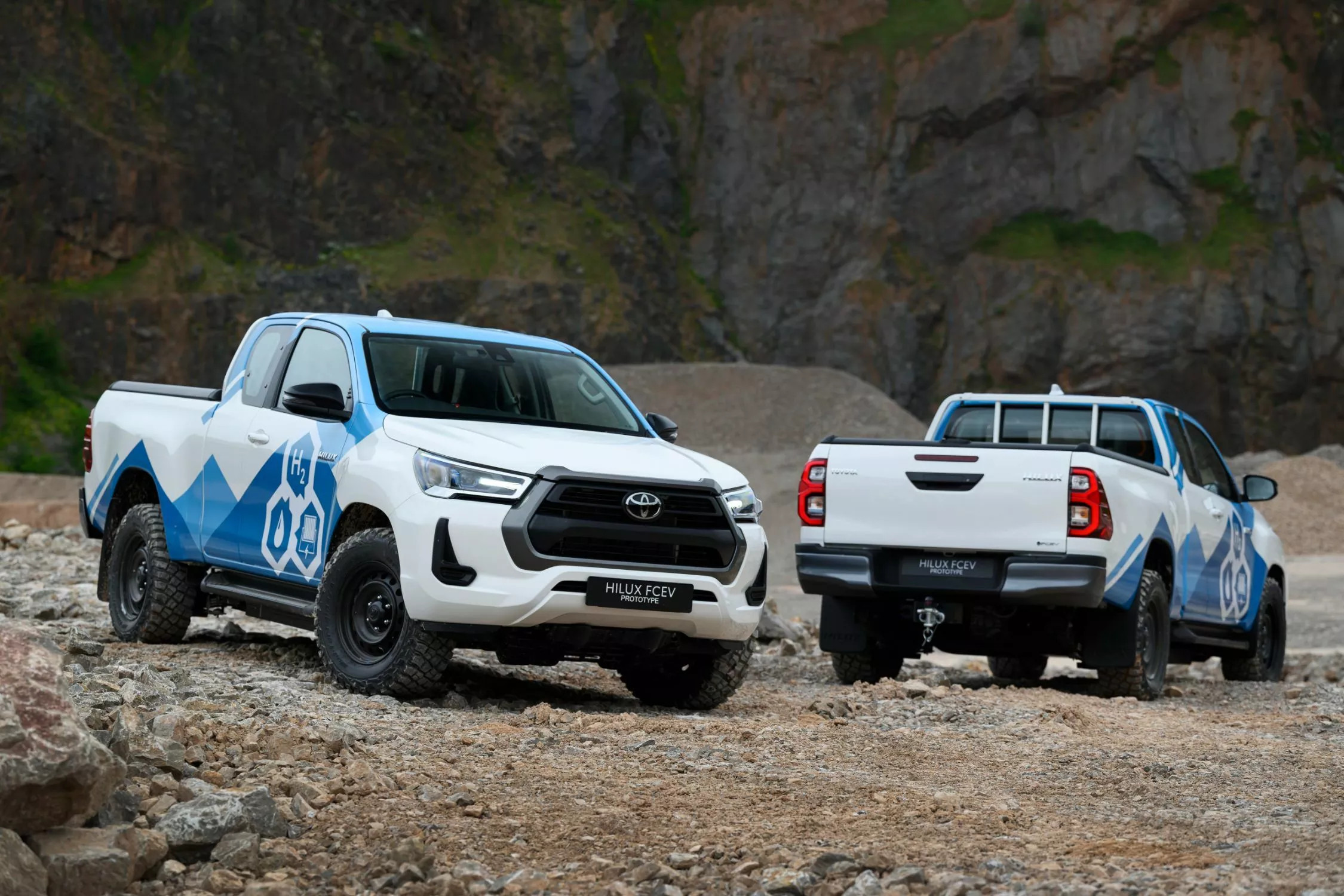
Toyota revealed its first Hilux H2 prototype in 2022, using the Mirai sedan’s fuel cell powertrain. In 2024, the automaker produced 10 FCEV truck prototypes for testing in the UK. They featured three hydrogen tanks built into the ladder-frame chassis and a lithium-ion battery beneath the rear bed, delivering a claimed range of 600 km (373 miles). A rear-mounted electric motor supplied 180 hp (134 kW / 182 PS) and 300 Nm (221 lb-ft) of torque.
Toyota’s Stellantis-Sourced LCVs
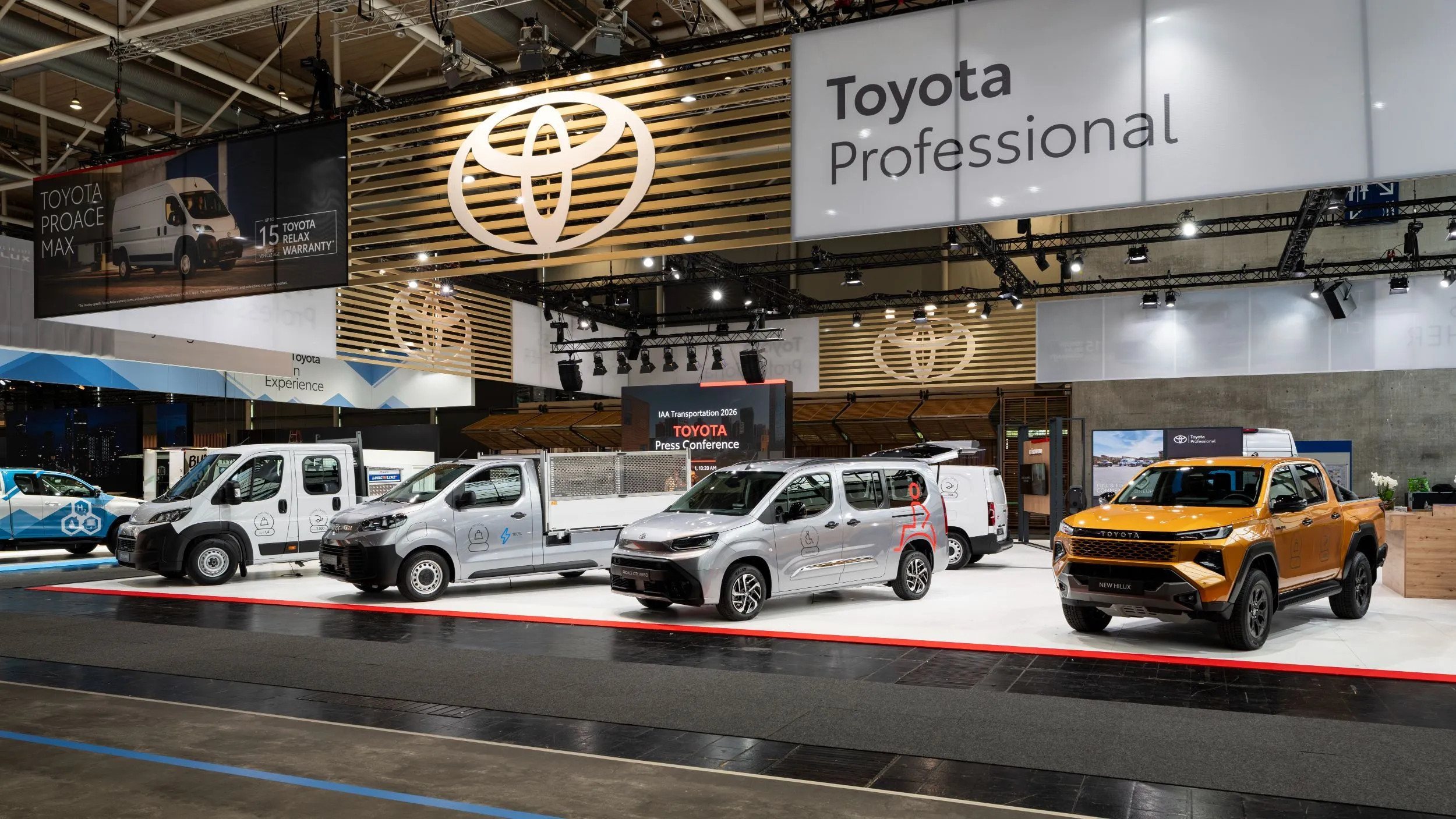
Alongside the Hilux FCEV announcement, Toyota displayed its European LCV range at the IAA Transportation show in Hannover, Germany. Toyota’s European LCV sales have more than doubled in the past five years, and the company expects to sell more than 165,000 units in 2026, representing a market share above 7%. Its target is to reach 200,000 annual LCV sales in Europe by 2030, lifting its share to 8%.
In addition to the in-house-developed Hilux pickup, Toyota’s European LCV lineup includes compact, medium, and large Proace vans sourced from Stellantis. This arrangement enables Toyota to offer BEV versions throughout its LCV range, with zero-emission models making up 22% of LCV sales—twice the 11% market average.
Toyota “recognizes that a single technology solution cannot address the business requirements, mobility needs or the local operating environments of all customers,” so it continues to offer diesel powertrains. These engines can also use renewable fuels such as HVO, helping to reduce carbon emissions.


The Toyota RAV4 remains a popular compact SUV, but its value and capabilities face strong competition from five hybrid alternatives.

Volkswagen has owned Bentley since 1998, but the luxury marque remains closely tied to its historic Crewe factory, where its current models are assembled in England despite their extensive German engineering and component links.

Tesla’s latest Roadster remains unconfirmed for production, but its dramatic debut included airborne stunts that few cars could match.

A fire at Frank Kent Cadillac in Fort Worth, Texas, destroyed six electric SUVs believed to be Cadillac Escalade IQs and took nearly 18 hours to bring under control.

A Ferrari F50 with just 106 miles on its odometer is expected to surpass $20 million at auction on October 31, potentially setting a new record for the model and highlighting its rapid rise in collector value.