
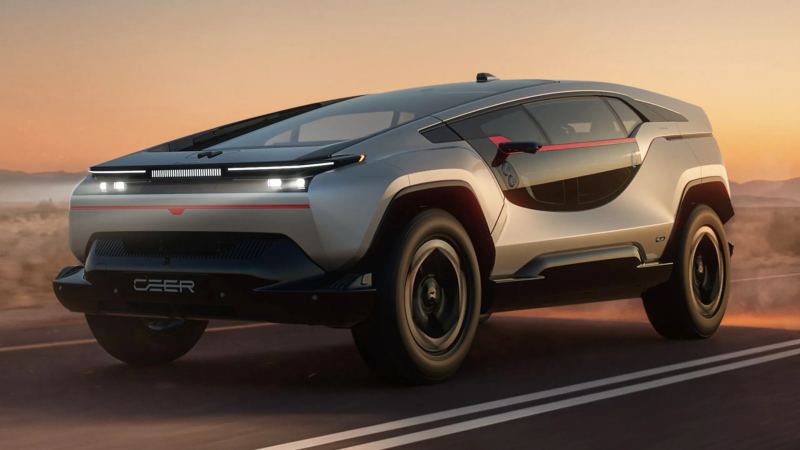
Following years of promises and development, Saudi Arabia’s homegrown Ceer brand has revealed two striking EVs that appear more like show cars than production vehicles. They are, however, genuine production models and will be built at a dedicated facility in King Abdullah Economic City.
Called the Exobot, the new model will be available as both a sedan and an SUV. Although several ambitious EVs from startup automakers have been unveiled in recent years only to disappear, Ceer is backed by a country with the resources to put these vehicles on local roads. Persuading Saudi buyers to choose them could be a more difficult task.
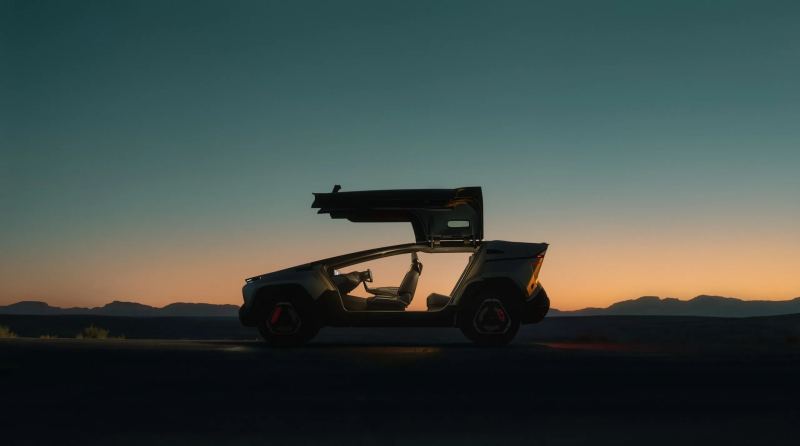
The sedan and SUV are distinguished by dramatically angled, nearly flat windshields that flow directly into the hoods. Ceer says the Exobot’s 94.4-inch (2.4-meter) windshield is the largest fitted to any production car. Both models use slim headlights and daytime running lights, while the SUV adds a rugged-style bumper.
Large Dimensions, Serious Power
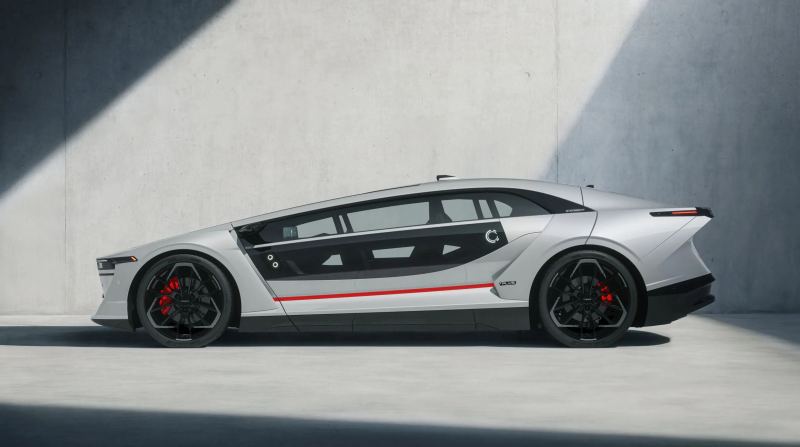
Ceer’s two EVs are substantial in size. The sedan measures 207 inches (5.26 meters) long, 82.6 inches (2.1 meters) wide, and 56.2 inches (1.43 meters) tall. The SUV is slightly shorter at 197.6 inches (5.02 meters), while sharing the sedan’s 82.6-inch (2.1-meter) width and standing 66.5 inches (1.69 meters) tall. Both feature gullwing-style doors, which Ceer calls Shahin Wing Doors after the Shahin falcon.
Ceer developed the Exobot with outside partners. The company was formed as a joint venture with Foxconn and is reportedly using BMW electric drive systems.
In its most powerful form, the Exobot uses three electric motors to deliver 1,111 hp and 1,106 lb-ft (1,500 Nm) of torque. The sedan can accelerate from 0 to 62 mph (100 km/h) in 2.1 seconds and reach 155 mph (250 km/h), while the SUV completes the sprint in 2.4 seconds and tops out at 130 mph (210 km/h).
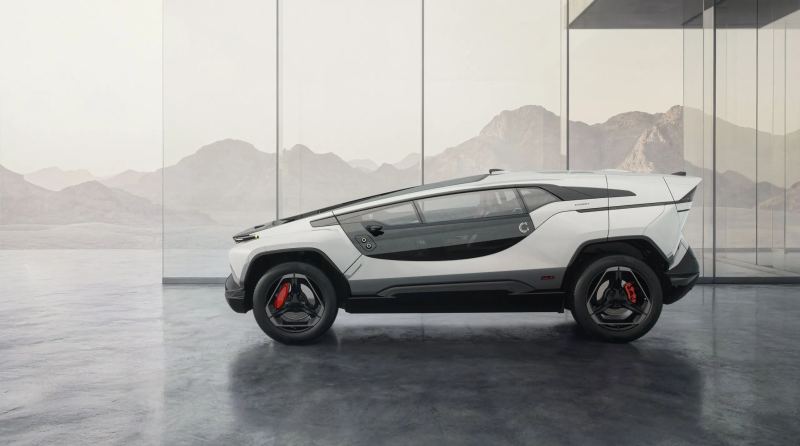
The Exobot will initially launch in a limited First Edition specification. With 850 hp and 738 lb-ft (1,000 Nm) of torque, the sedan reaches 62 mph in 2.6 seconds, while the SUV takes 2.9 seconds.
Both body styles use a 112 kWh battery. The sedan is rated for 416 miles (670 km) of range, while the SUV can travel 348 miles (560 km). Their 800-volt electrical systems reportedly allow a 10-to-80-percent charge in under 30 minutes.
With so much glass and Saudi Arabia’s intense heat, cabin temperatures could quickly become a concern. Ceer says the Exobot uses triple silver-coated glass and a powerful cooling system capable of lowering the interior temperature from 65°C (149°F) to 32°C (90°F) in 10 minutes.
What Else Is Coming?
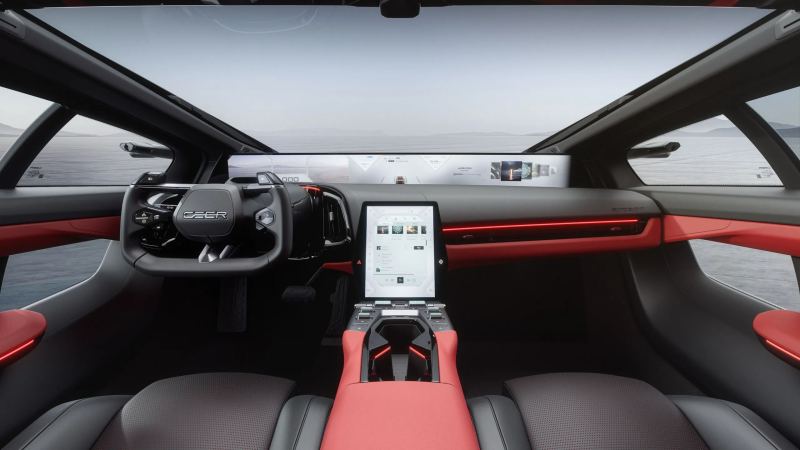
Interior highlights include a 48-inch display spanning the top of the dashboard, a 10.4-inch central infotainment screen, and an 8-inch display for rear passengers. The Exobot also features a yoke-style steering wheel, an AI-powered voice assistant, and over-the-air update capability. Ceer promises hands-free self-driving with point-to-point navigation, but has not revealed the source of its autonomous-driving hardware or software.
Ceer has not yet announced pricing. The Exobot will be followed by five additional models scheduled to arrive between 2028 and 2030. While the company originally planned to produce only EVs, it has since expanded its strategy to include plug-in hybrids and vehicles powered solely by combustion engines.


The Toyota RAV4 remains a popular compact SUV, but its value and capabilities face strong competition from five hybrid alternatives.

Volkswagen has owned Bentley since 1998, but the luxury marque remains closely tied to its historic Crewe factory, where its current models are assembled in England despite their extensive German engineering and component links.

Tesla’s latest Roadster remains unconfirmed for production, but its dramatic debut included airborne stunts that few cars could match.

A fire at Frank Kent Cadillac in Fort Worth, Texas, destroyed six electric SUVs believed to be Cadillac Escalade IQs and took nearly 18 hours to bring under control.

A Ferrari F50 with just 106 miles on its odometer is expected to surpass $20 million at auction on October 31, potentially setting a new record for the model and highlighting its rapid rise in collector value.